Showing posts with label Gloucestershire. Show all posts

Friday, 30 January 2026

Thomas Henry Richards Gardner and Mary Ann Watkins

St George Hanover Square
cc-by-sa/2.0 - © Stephen Richards - 
geograph.org.uk/p/7728390
Thomas Henry Richards Gardner, bachelor, servant, then of Brook StreetMayfair (bap. 25 Dec 1825 in Dursley, Gloucestershire), who listed his father as Thomas Richards Gardner, Carpenter, but was actually the son of Mary Ann Gardener, Single woman (and very likely a Mr Richards), married Mary Ann Watkins (b. ~1829 in St George, Hanover Square), spinster of Swan Passage, daughter of James William Watkins, Coachman, and Mary Wells, at St George, Hanover Square, on 30 Jan 1854. Witnesses were James William Watkins and Mary Watkins, presumably the bride's parents.

Thomas Henry Richards and Mary Ann Gardner had seven children:
  1. Thomas James Gardner b. 17 Mar 1854 (1854 J Quarter in SAINT GEORGE HANOVER SQUARE Volume 01A Page 171), bap. 28 May 1854 (as Thomas James Charles Augustus Gardner) at St George, Hanover Square. Evidence of a marriage in 1885. Died at 39 in 1892 M Quarter in POPLAR Volume 01C Page 612
  2. Henry James Gardner b. 23 Jan 1856 (1856 M Quarter in BETHNAL GREEN Volume 01C Page 320), bap. 11 May 1856 (as Henry James William Gardner) at St George, Hanover Square. Died at 29 in 1885 J Quarter in POPLAR Volume 01C Page 416
  3. Charles Albert Gardner b. 31 Mar 1859 (Registered 1859 J Quarter in SAINT GEORGE HANOVER SQUARE Volume 01A Page 183), bap. 7 May 1859 at St George, Hanover Square. (Died in 1901).
  4. Ann Gardner b. 1862 M Qtr in POPLAR UNION Vol 01C Page 630. (No further records found, so assume died shortly after birth or in infancy.)
  5. Albert Edward Gardner b. 1864 S Quarter in POPLAR Vol 01C Page 596. Died aged 3 in 1867 S Quarter in POPLAR Vol 01C Page 407
  6. Mary Ann Gardner b. 1867 S Qtr in POPLAR UNION Vol 01C Page 604. Died at 63 in 1931 J Quarter in STEPNEY Vol 01C Page 240 
  7. Albert Gardner b. 19 Jul 1870 in POPLAR UNION Vol 01C Page 623
On all of the registrations the mother's maiden name is WATKINS.

In 1861, Thomas Gardner (31) Ship builders labourer, Mary Ann Gardner (32), Henry Gardner (5) and Chares Gardner (3) were living in the household of Thomas' brother, James Gardner (28) Sawyer from Gloucestershire and his wife Barbara Gardner (24) from Norfolk, at 4, Maud Place, Bromley, Poplar. Thomas Gardner (7) was staying with his grandmother, Mary Watkins (67) Widow, at 5, Swan Cottages, St George Hanover Square.

(Didn't find any birth / baptism record for James Gardner, but he was presumably also a 'natural' son of Mary Ann Gardner. In 1871, James Gardner (38) Manager of Sawmills from Dursley, Gloucestershire, was living in Udimore Road, Rye, Sussex with Barbara Gardner (33). Then James Gardner died, aged 43, in 1876 M Quarter in RYE Volume 02B Page 3 and was buried on 6 Mar 1876, in Rye, Sussex. In 1881, Barbara Gardner (44) Widow, Laundress, was living in Cinque Ports Street, Rye, Sussex. Barbara Gardner died at 76 in 1913 M Quarter in HAILSHAM Volume 02B Page 137.)

In 1871, Thomas Gardner (42) Gas Fitter from Dursley, Gloucestershire was living in Guilford Road, Bromley, Poplar with Mary Ann Gardner (40), Thomas Gardner (17), Henry Gardner (14), Charles Gardner (11), Mary Ann Gardner (3) and Albert Gardner (8 months).

In 1881, at 34, Guildford Road, Bromley, Poplar, were Thomas Gardner (50) Gas Fitter; Mary A Gardner (49), Thomas Gardner (27) Gas Fitter; Henry Gardner (25) Slater; Charles Gardner (22) Slater; and Albert Gardner (11). 

In 1891, Thomas Gardner (62) Gas Fitter was at 12, Bloomfield Road, Mile End Old Town, with Mary Ann Gardner (66) and Albert Gardner (20) Printer.

In 1901, Thomas Gardner (75) Gas Fitter was living at 150, Queens Road, West Ham with Mary A Gardner (73) Shirt maker; Mary A Gardner (32) Shirt maker; and Albert Gardner (30) Post Office porter.

Thomas Henry Richard[s] Gardner died, aged 86, in 1907 D Quarter in WEST HAM Volume 04A Page 51.

In 1911, Mary Ann Gardner (84) was living with son Alfred Gardner (40) Printer porter and his wife Susannah (40) at 268 Devons Road, Bow, Poplar (Alfred Gardner had married Susannah Mary Brown in 1908), with Mary Ann Gardner (42) Shirt machinist; and Albert and Susannah's daughter, Rosetta Mary Gardner (6 months). On this census it lists that Mary Ann Gardner had seven children, of whom five had died and only two were then still living. 

Mary Ann Gardner died at 88 in  1917 M Quarter in MILE END OLD TOWN Volume 01C Page 489.

Monday, 8 December 2025

Captain William Layman RN and Elizabeth Perry

HMS Victory, June 1987
Photo available for reuse under this Creative Commons licence.

William Layman (b. ~1765), then of the Parish of St George the Martyr, Southwark, Bachelor, married Elizabeth Perry (b. 15 Jan 1772, bap. 16 Jan 1772 at St Dunstan's, Stepney), of this Parish, Spinster, eldest surviving daughter of John Perry and Elizabeth Brown, by Licence, at St Dunstan's, Stepney on 8 Dec 1798. Witnesses were her father, John Perry, and her brother, Thomas Perry. (Elizabeth's father was John Perry, Shipbuilder of the Blackwall Yard, who built ships largely for the East India Company.)

William Layman by
Sir Thomas Lawrence
Confirming the above, in 1798, 1799 and 1800, the Surrey, England, Land Tax Records, 1780-1832, show that William Layman was paying ground rent to Countess Dowager Gower and Co, for a property in Rotherhithe (now within the London Borough of Southwark), an area known for its rich maritime history.

It would seem that the couple had at least one daughter, Mary Ann Layman, born around 1800. A reputed date of birth of 28 May 1801 has been suggested, but no primary source has been offered (nor found) to confirm this. Her burial record shows that she was buried on 13 June 1814, at Poplar Chapel (St Matthias Old Church), listed as Mary Ann Laman (sic) from Brompton (Chelsea), aged 14. 

Layman was a protégé of Lord Nelson, with whom he served in three ships. It's said that Layman entered the navy in 1782 on board the Portland [HMS Portland (1770)], served for four years (1782–6) in the Myrmidon, and a year and a half (1786–8) in the Amphion [HMS Amphion (1780)] in the West Indies. "In the end of 1796 he was for a few months in the Isis [HMS Isis (1774)] in the North Sea." (To have sight of the original ships' musters, etc., to confirm these, would require a visit to The National Archives.)

"He seems then to have gone into the merchant service, and was especially employed in the East India and China trade." This is confirmed in the UK, Registers of Employees of the East India Company and the India Office, 1746-1939, wherein, in 1797-1799, William Layman, Residence India, is named as the Commander of the ship Britannia [British Merchant merchantman 'Britannia' (1794)], which although privately owned made voyages for the East India Company. Layman appears to have made one voyage for the EIC as commander of this Britannia, from China in 1796, reaching The Downs (off the east Kent coast) on 9 Feb 1797.

In 1800, William Layman returned to the navy under the patronage of Lord St. Vincent. "He passed his examination on 5 June 1800, when, according to his certificate, which agrees with other indications, he was thirty-two years of age." [Source] [1] (Unfortunately, I haven't seen the certificate, which again would require a visit to The National Archives.) He served for a few weeks in the Royal George [HMS Royal George (1788)], St. Vincent's flagship, in the blockade of Brest, and was promoted to be lieutenant of the Formidable [HMS Formidable (1777)] with Captain Thornbrough (Admiral Sir Edward Thornbrough) on 12 Sept. In December, at Lord Nelson's wish, he was appointed to the San Josef [HMS San Josef], and in February 1801 to the St. George [HMS St George (1785)]. "Nelson took up the cause of William Layman, who had been with him as a Lt. at CopenhagenBattle of Copenhagen (1801) [Source]. In the battle of Copenhagen Layman was lent to the Isis, in command of a party of men sent from the St. George. 

On the recommencement of hostilities, Lord Nelson nominated Mr. Layman to be lieutenant of the Victory - position he held between 4 April 1803 and 16 October 1803, dates which are confirmed in the Ship's Muster Record for Victory, but as an officer, it reads "Per Commission" in the column where, for other ranks, it would list their place of birth - in which ship he sailed with his Lordship for the Mediterranean in May, 1804. In the way out, the Victory retook the Ambuscade frigate, of which Mr. Layman was sent in charge; and on the passage to Gibraltar, captured a French ship and Dutch vessel.

Soon after, re-joining Lord Nelson off Toulon, he [Layman] was appointed, in October, by his Lordship, to the command of the Weazle [HMS Weazel (1799)]; in which vessel Captain Layman was immediately despatched to watch the enemy's cruisers, and protect the trade of the Straits, as well as keep open the conveyance of provisions from the coast of Barbary for the supply of the garrison of Gibraltar. In February, 1805, Lord Nelson wrote to Captain Layman, signifying his high approbation of the manner in which the service of the Gut had been executed, and hoping soon to be able to give him a better ship; but this commendation Captain Layman did not receive till after the Weazle had been unfortunately wrecked. [Source] (Weazle was wrecked on 1 March 1804 off Cabritta Point near Gibraltar with the loss of one man of her crew of 70.) [The service of the Gut of Gibraltar refers primarily to the pivotal naval engagements, particularly the First and Second Battles of Algeciras (July 1801) during the French Revolutionary Wars, where the Royal Navy used the strategic narrow strait to challenge French and Spanish fleets attempting to reinforce Egypt. It also signifies the ongoing strategic role of Gibraltar as a Royal Navy base, controlling the gateway between the Atlantic and Mediterranean for centuries, with regular naval patrols and operations ensuring shipping safety.]

Mainly in consequence of the representations of the merchants of Gibraltar, warmly backed up by Nelson, Layman was nevertheless promoted to the rank of commander on 8 May 1804, and appointed a few months later to the Raven sloop, British sloop 'Raven' (1804), in which he sailed on 21 Jan 1805, with despatches for Sir John Orde and Nelson. On the evening of the 28th he arrived at Orde's rendezvous off Cadiz, and, not seeing the squadron, lay to for the night, during which the ship was allowed to drift inside the Spanish squadron in the outer road of Cadiz. Layman's position thus became almost hopeless, and the next morning in trying to escape the ship was driven ashore near Fort Sta. Catalina. HMS Raven was wrecked in Cadiz Bay, on 30 Jan 1805. Raven was built at his father-in-law's yard (John Perry retired in 1803, a year before HMS Raven was ordered). The circumstances and details of the Court Martial, on 9 Mar 1805, are already covered at the Wikipedia pages for William Layman and HMS Raven and in the Royal Naval Biography of Layman, William compiled by John Marshall, so I won't repeat all of it, except to note that the court-martial minutes include a note by an Admiralty official that said, "Their Lordships are of the opinion that Captain Layman is not a fit person to be entrusted with the command of one of H.M.'s ships."

Would Layman have been at Trafalgar in the October, had he not been Court Martialled in the March? And if he had, would he have survived that battle? Is it probable that if Nelson had lived, he would have continued to defend his protégé and gained him further employment? We will never know.

It seems incongruous that one moment, Nelson is strongly commending an officer who appears to be highly competent, but who then, in the next moment, is shown to have acted with a lack of caution. Despite promoting him, Nelson too seems to have been of the opinion that Layman let his mouth run away with him and Nelson is even reported to have said that the worst thing that happened to Layman was that he learned to write. There was a huge volume of correspondence (longwinded and flowery, which may have simply been the style of the period) from Layman leading up to the commissioning of the Raven, then there were the constant 'ideas' he would send to the Admiralty after his Court Martial. If we add in the circumstances of his demise, I have to say (and I would stress that I'm no expert), but what I'm reading sounds like someone who today we would say was bipolar.

Among his copious output of writings was "the syllabus of a contemplated maritime history from the earliest times (including the building, plans and navigation of the ark, with notes on the weather experienced) to the termination of the second American War." And in his biography, is written: "Perhaps the syllabus may be considered as indicating even then an aberration of the intellect which caused him to 'terminate his existence' in 1826."

On 4 July 1810, William Layman was writing (to the Admiralty, with one of his 'ideas') from Haywood House (sic) near Cobham, Surrey (Heywood House - ACS International School Cobham). There is very little history of the house and nothing to indicate why Layman was there, although a Thomas Baker (1793–1871) was linked to Cobham with East India connections. Baker, became a captain of East India Company ships trading with India and China in the 1820s. He and his wife inherited the house called Owletts in Cobham in 1835. Baker doesn't seem to have any direct link to Heywood House, but he surely was the same Thomas Baker, Carpenter on HMS Raven.

On 22 Jan 1811, Layman wrote (regarding the loss of HMS Raven), from 9 Queens Buildings, Brompton (Chelsea). The location "9 Queens Buildings, Brompton" appears to refer to a historical address, as the entire road frontage known as "Queen's Buildings" was renumbered and renamed to Brompton Road, London SW3 (Royal Borough of Kensington and Chelsea) in 1864. 

Captain William Layman's house at
34 Hans Place, centre of picture.
From 1816 onwards, London, England, Land Tax Records, 1692-1932, show Captain William Layman paying ground rent to The Lords of the Manor in St Luke, Chelsea, Kensington and Chelsea, first as Sloane Street, then as 34, Hans Place (Hans Place is a garden square in the Knightsbridge district). It would be hard to find anywhere more 'fashionable'. Interestingly, 34 Hans Place is one of only a couple of houses of original construction left there (the six bed, six bath, Georgian townhouse last sold for £13,300,000 in 2023). Jane Austen's brother had lived at 23, Hans Place and the author had stayed there with him in 1814-15, while writing Emma. The Austens and the Laymans may have missed each other by a year, but as number 23 is one of the houses that was subsequently rebuilt, it is (unknowingly) William Layman's house that is used to show what Henry Austen's house would then have looked like.

The Times (May 27th 1826 page 3 column D) report of the coroner's inquest, held at The Swann InnCheltenham, on 25 May 1826, into William Layman's death is reproduced in this thread (from 2006) at the forum, Admiral Lord Nelson & his Navy. That newspaper report details that Layman had killed himself on the previous Tuesday, which was 23 May 1826. He had been found in the bath, with his throat cut. Apparently, he had "undressed himself and had hung up his clothes in the greatest order." It confirms Layman's town residence as No.34 Hans Place, Sloane Street and that he had taken up residence at Woodland Cottage. The deceased is described as "about sixty years of age, a married man, without family." It seems he exhibited many strange behaviours in the lead up to his death. Not unsurprisingly, the Jury, after a short consultation, returned a verdict of "Insanity". 

Captain William Layman RN (the full title listed on the burial record), with abode listed as Cheltenham, was buried at Leckhampton (described as "a desirable, leafy suburb south of Cheltenham, Gloucestershire"), presumably at St Peter's Church, on 29 May 1826, with his burial, curiously, officiated by John Portis, Rector of Little Leighs, Essex. It was fortunate that he was not declared a Felo de se and given a "shameful burial" (at night with no clergy and no mourners), so I suspect that his and particularly his widow's social status had some bearing. His age at death was given as 61, which sounds like someone knew, rather than a guessed rounding to 60. 

[1] It is immensely frustrating that none of the records I can access, and I'm not convinced that the ones at the National Archives at Kew would yield anything more, do not give any clues to Layman's origins. It was said that he is listed as having been 32 years old in 1800, which would calculate to a birth year of 1768, and that 'other indications' agree. Those other indications, I assume are other parts of his naval record. Here's what I think: the age on that 1800 certificate is most likely calculated from the age he said he was when he joined his first ship in 1782. If he had been born in 1768, that would have made him 14 then. In the 1870's, "Boys for the Navy must be over 15 and not above 16½ years of age ..." Prior to that, I know boys could join earlier, because I have a 2x great-grandfather who went to sea at 10, but maybe the upper limit existed earlier. If Layman was born in 1765, the birth year that calculates from his age at death, he would have been 17 in 1782, probably already too old to be taken on for training. He would be far from the first, nor the last, to massage his age to what he needed it be, so I'm more apt to believe that he will have lied about his age to the Navy. IF he was indeed born in 1765, there's a potential baptism of a William Layman, son of John Layman and Joan Salter, in Plymtree, Devon on 9 Apr 1765, but I would caution that I cannot see a way to definitively prove or disprove that being relevant.

What we do know is that William Layman must have had some education to be able to read and write. Otherwise, he could have come from 'nowhere' and achieve this career in the Navy. I'm less likely to believe that John Perry would be happy to allow his eldest daughter to marry someone who did not come from some sort of a decent background, but what that was, if it was more than just his naval connections, we shall probably never know.

William Layman's Will, written on 24 April 1817, is short and to the point, it reads, "I give and bequeath unto my dear wife Elizabeth Layman the lease of my house at 34 Hans Place together with the furniture and all the other effects therein at the time of my [decease] and also all other [of] my personal property whatsoever in [unreadable] she shall survive me and I make my said wife Executrix of this my Will and Testament ..." It was proved at London on 23 Jun 1826 by the Oath of Elizabeth Layman Widow and Relict the sole executrix to whom administration was granted.

Elizabeth Layman, 64, abode Chelsea, reputedly died at 34 Hans Place, on 14 Jan 1837 - which was the day before her 65th birthday - she was buried on 20 Jan 1837, at Poplar Chapel (St Matthias Old Church), where her parents, grandparents and great-grandparents were also buried.

There was never any doubt that this was Elizabeth Perry, daughter of John Perry, but this transcription of Elizabeth's will (as best I can, because a few words are indistinct), leaves absolutely no doubt as to who she was: 

"This is the last Will and Testament of me Elizabeth Layman of Hans Place in Middlesex Widow. I give the sum of eight thousand pounds that per Cout Consolidated Bank Annuities [2] bequeathed to me by the Will of my late Brother Philip or the Storks Funds and Securities on which the same are now or at the time of my [death/demise] may be invested unto my Sister Charlotte Bonney and Louisa Perry in equal shares and whereas under the Will of my late Brother John Perry I have a power of disposition after my [decease] by any writing under my hand over the sum of six thousand pounds Sterling or are the Storks Funds and Securities upon which the same may be invested. [Unreadable] of such power and in exercise thereof I do by the writing under my hand appoint the said sum of six thousand pounds or the said last mentioned Stork Funds and Securities after my decease unto between and amongst all and every [...] the children of my late Brother Thomas Perry who may be living at the time of my decease and in equal shares and whereas under a Deed of Covenant dated the fifth day of March One Thousand Eight Hundred and made between my late father John Perry of the one part and my late husband William Layman and myself of the other part I have a power of appointment by my last Will and Testament duly executed over our ???? of a sum of four thousand pounds Sterling (which said four thousand pounds now invested in the sum of eight thousand five hundred and ninety pounds seventeen shillings and eight pence there by Cout Consolidated Bank Annuities in favour of such of my brothers and sisters as shall be living at my decease. Now by virtue of last mentioned power and in exercise thereof I do by this my last Will and Testament duly executed by me ????? Direct and appoint the said ???? Of the said sum of four thousand pounds or the Storks Funds and Securities whereon the same is now invested unto and to be equally divided amongst my four brothers and sisters George, Mary Ann, Charles and Amelia in equal shares and as to my house in Hans Place in which I now dwell and all other of my Real and Personal Estate whatsoever and wherever and all other Real or Personal Estate over which I may have any power of disposition I give and bequeath and appoint the same subject to the payment of my debts and funeral and testamentary expenses unto my brother Richard Perry executor of this my Will and hereby revoke all former Wills by me at any time heretofore made …. Etc. The Will was proved at London on 30 Jan 1837 by the oath of Richard Perry Esquire the Brother … (Note that Elizabeth makes no distinction between her full and half siblings.)

By my calculations Elizabeth was leaving funds worth at least £18,000 (about £2.5M today), plus the leasehold property in Hans Place, plus whatever else we don't even have a number for. A very considerable fortune.

[2] I assume Cout means Coutts & Company. Consolidated Bank Annuities, or "Consols," were perpetual British government bonds issued by the Bank of England starting in 1751, consolidating various debts into one perpetual stock with a fixed interest rate (initially 3%) and no maturity date, providing a reliable, if varying in value, income stream until the UK government redeemed the last outstanding consols in 2015, though the concept historically symbolized national debt management.

Monday, 1 December 2025

Walter Robert Thomas Parry and Emma Hockley

Holy Trinity Church, Hartland Road, London NW1
cc-by-sa/2.0 - © John Salmon - geograph.org.uk/p/1292924

Walter Robert Thomas Parry (bap. 16 Apr 1851 at St Mary's ChurchCharlton Kings, Gloucestershire), son of Walter George Parry and Annie Arnott, married Emma Hockley (bap. 13 Apr 1851 at St Mary the Virgin, Great Dunmow), daughter of George Hockley and Eliza Crow, at Holy Trinity ChurchHaverstock Hill (Haverstock) on 1 Dec 1872

The previous year Emma was working as a General servant to Samuel Knight, Architect at Maitland Park Villas, St Pancras. Walter R Parry (20) Carpenter & Joiner, had been Lodging at Collyer Cottages, High Street, Camberwell.

Walter and Emma had one daughter:
  1. Annie Emma Parry b. 1873 M Qtr in ST PANCRAS Vol 01B Page 178, who died, aged 5, in 1878 S Qtr in PANCRAS Vol 01B Page 111
In 1881, Walter R Parry (28) Joiner from Gloucestershire, Emma Parry (28) from Essex were at 152, St Pauls Road, St Pancras, London with Walter's aunt, Elizabeth White (56) Widow from Somerset living with them.

Then Emma Parry died, aged 37, in 1889 S Quarter in CHELTENHAM Volume 06A Page 215.

Walter Robert Thomas Parry remarried, in 1892, to Sarah Ann Burrows, in Northleach, Gloucestershire.

And went on to have two further daughters: 
  1. Clara Daisy Parry b. 1895 J Qtr in NORTHLEACH Vol 06A Page 378
  2. Frances Lily Parry b. 1896 S Qtr in CHELTENHAM Vol 06A Page 400
The family were living in Charlton Kings, Cheltenham, in 1901 and 1911. 

Walter Robert Thomas Parry of 3 Daisy Bank, Charlton Kings, Cheltenham, died, aged 77, on 24 Jul 1928 (1928 S Quarter in CHELTENHAM Volume 06A Page 371). Probate was granted to Clara Daisy Williams (wife of Francis Herbert Williams) and Frances Lily Hatherall (wife of John William Hatherall).

Sunday, 2 November 2025

James Shopland and Loveday Jane Stone

Bridge and Uplowman church
cc-by-sa/2.0 - © David Smith - geograph.org.uk/p/4097757

James Shopland (b. 1885), son of James Shopland and Caroline Sydenham, married Loveday Jane Stone (b. 6 Apr 1884), daughter of Frederick James Stone and Loveday Jane Land, at St Peter’s ChurchUplowman on 2 Nov 1904. Witnesses were Mary Ann Stone and Frederick James Stone. 

James Shopland's father, James Shopland (1850-1908), was a Wheelwright and Carpenter of Chevithorne Village. In 1901, James Shopland (16) had been employed as a Dairyman's Labourer to Samuel B Thornton, residing at The Island Cottage, Lowman Green, Tiverton. Then, on 8 Jun 1901, adding two years to his age and claiming to be 18 years and 3 months, James Shopland, enlisted for Short Service in the Devonshire Regiment and served until 7 Jun 1913, when he was discharged at the end of his first period of engagement. James' record says he passed classes as Mounted infantry, Certified. From 23 Jul 1902 until 21 May 1903, James served in South Africa, in the aftermath of the Second Boer War. From 22 May 1903, until his discharge, he was assigned to Home, presumably actual home, as a reservist.

James and Loveday had four children:
  1. Frederick James Shopland b. 19 Nov 1905 (1905 D Quarter in TIVERTON Volume 05B Page 368), bap. 17 Dec 1905 at St Peter's Church, Tiverton, as the family's address then was 3 Adam's Court, Barrington Street, Tiverton. 
  2. Loveday Jane Shopland b. 14 Feb 1907 (1907 J Quarter in TIVERTON Volume 05B Page 373), bap. 17 Feb 1907 at Cove
  3. Albert Geoffrey Shopland b. 21 Jul 1908 (1908 S Quarter in TIVERTON Volume 05B Page 357). 
  4. Sidney Arthur Shopland bap. 27 Feb 1910 at Bickleigh (1910 M Quarter in TIVERTON Volume 05B Page 337)
In 1911, living at New Cottages, Seckerleigh Farm, Halberton, were James Shopland (27) Farm Labourer, Loveday Jane (27), Frederick James (6), Loveday Jane (4), Albert Geoffrey (3), Sidney Arthur (1) and boarder, Robert Charles Harris (38) Farm Labourer, from Penzance, Cornwall. 

In 1921, James Shopland (35) was working for the Great Western Railway at Temple Meads Station, Bristol, and was living at 34, Pylle Hill Crescent, Totterdown, Bristol, with Loveday J Shopland (37), Frederick J Shopland (15) Machanist (Printing); Loveday J Shopland (14) Out of work; Albert J Shopland (12) and Sidney A Shopland (11).

In 1939, Loveday Jane Shopland was still at 34 Pylle Hill Crescent, Bristol, with daughter, Loveday Jane Southcott. James was not listed. 

Loveday Jane Shopland died, aged 56, in 1941 M Quarter in TAUNTON Volume 05C Page 912. 

James Shopland died, at 69, in 1955 S Qtr in BRISTOL Vol 07B Page 68.

  1. Frederick James Shopland married Elizabeth A P Cox (b. 1 Mar 1906) in Bristol, in 1927. In 1939, were at 131 Eden Grove, Bristol, with three other people in the household. Frederick James Shopland died in 1971, in Weston-super-Mare.
  2. Loveday Jane Shopland married Leonard Southcott in Bristol in 1928. Their address in 1939 was 34 Pylle Hill Crescent, Bristol. Leonard Southcott died, aged 47, in 1950 S Quarter in BRISTOL Volume 07B Page 49. In 1952, Loveday Jane Southcott remarried to a James John Basten Rank (b. 1898 in Wandsworth), son of James Rank and Rose Basten. James J B Rank died, aged 68, in 1966, in Weston-super-Mare. Loveday Jane Rank died in Q1/1995 in TAUNTON (7241B) Reg B62B Entry Number 168. There's also a record of her death listed as Loveday Jane Southcott. 
  3. Albert Geoffrey Shopland married Annie Richards (b. 30 Sep 1911) in Bristol in 1930 and in 1939 they were living at 3 Chessington Avenue, Bristol. Albert G Shopland died, at 35, in 1944 S Quarter in BRISTOL Volume 06A Page 48.
  4. On 13 Jun 1929, Sidney Arthur Shopland enlisted in the Royal Artillery. Sidney A Shopland died, aged 58, in 1968, in Bristol.

Monday, 12 May 2025

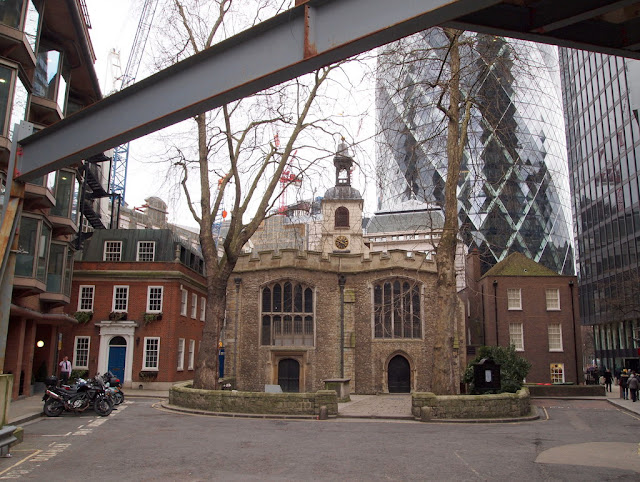
Augustine Wynnall and Elizabeth Knighte

Great St Helen's Street, London, EC3
cc-by-sa/2.0 - © David Hallam-Jones - geograph.org.uk/p/3406231
The Grade II-listed 12th century Church of "St Helen's, Bishopsgate" occupies the centre space. This was William Shakespeare's parish church when he lived in the area in the 1590s.

Augustine Wynnoll (sic) and Elizabeth Knighte (I suspect the final 'e' is superfluous) - a pair of my 9th great-grandparents - married at St Helen's, Bishopsgate (one of only a few churches in the City of London to survive both the Great Fire of 1666 and The Blitz), on 12 May 1634. (Which, for context was during the reign of Charles I of England. Interesting times.)

Augustine and Elizabeth appear to have had five children:

  1. Mary Winnall b. Monday, 17 Feb 1634, Mary daughter of Augustine Winnall of Blackwall, Waterman bap. 20 Feb 1634 at St Dunstan and All Saints, Stepney (at 3 days old).
  2. Elizabeth Winnall b. Tuesday, 29 Aug 1637, Elizabeth daughter of Augustine Winnall of Blackwall, Waterman bap. 6 Sep 1637 at St Dunstan's (at 8 days old). Elizabeth daughter of Augustine Winnall of Blackwall, Waterman, was buried at St Dunstan's on 24 Feb 1640.
  3. Amy Winnall b. Friday, 1 Nov 1639, Amy daughter of Augustine Winnall of Blackwall, Waterman & Elizabeth bap. 6 Nov 1639 (at 5 days old)
  4. John Winnall b. Wednesday, 23 Mar 1642, John son of Augustine Winnall of Blackwall, Waterman and Eliz., bap. 31 Mar 1642 at St Dunstan's (at 8 days old).
  5. Rachell Winnall bap. 19 Oct 1643. Rachel daughter of Augustine Winnall of Blackwall, Waterman & Elizabeth, buried 20 Nov 1643.
Their seemingly only son, John Winnall, who was my 8th great-grandfather, therefore, was born in the same year as the start of the English Civil War.

Sadly, almost all the records of the Company of Watermen prior to 1666 were destroyed in the Great Fire of London so finding these records of a waterman from before that time, is gold. That it's my direct ancestor, breath-taking.

Buried on page 408 of the Calendar of the Quarter Sessions Papers: pt. 1. 1591-1621, is the following item: 

If this is the same Augustine Wynnall (and, with the same fairly unusual name, just seven years before the above marriage, I imagine it must be), then several conclusions may be drawn: he appears to have been wanted to appear before the Quarter Sessions for some reason that I have yet to discover; he probably originally hails from Buckland, Gloucestershire and he had been a Labourer. Lending more circumstantial evidence for accepting that this is the right man, is that among the notable burials at St Helen's Church, Bishopsgate is the tomb of Sir Thomas Gresham (1519-1579), royal agent to King Edward VI (1547–1553) and Queens Mary I (1553–1558) and Elizabeth I (1558–1603) and founder of the Royal Exchange, whose father, Sir Richard Gresham (1485-1549), Lord Mayor of London, and Member of Parliament, who served as a commissioner under Henry VIII - both of whom had held the manor of Buckland. One imagines, therefore, that Augustine Wynnall had probably come to London in the service of their descendants.

Augustine Wynnall of Blackwall, Waterman was buried, on 2 Feb 1642, at St Dunstan's, Stepney. Being in the first part of the year, prior to March 25th, this was likely 1642 per the then used Julian calendar, which would equate to 1643 in our modern Gregorian calendar, making sense of the date of his youngest child. This also suggests Rachel was a posthumous child

Blackwall and the Watermen

Samuel Pepys, who commuted by water from his home to his job at the Admiralty, refers to the death of his waterman in his diaries of 1665 revealing the particular vulnerability of Thames watermen to infection. 

On Sunday 20 August 1665, he writes, "And I could not get my waterman to go elsewhere for fear of the plague."

Thames watermen and ferries: "Wherries could be hired at many stairs that led down to the Thames. Watermen gathered at each, jostling for custom, crying “oars oars sculls”. Working a passenger wherry, ferry, or barge on the Thames in all weathers and tides required knowledge and skill, with tides used to achieve remarkably quick journeys up and down river. The men who operated such craft, as well as those who transported goods by barge or lighter, were a special breed, whose families undertook the same work for generations."

Blackwall had a proud maritime tradition and both Raleigh and Nelson are said to have had homes here. The first colonists of Virginia sailed from Blackwall in 1606 and later the East India Docks - a group of docks in Blackwall, east London - brought thriving inter­na­tional trade.

Blackwall Yard was famous for building East Indiamen, which vessels were often called Blackwallers. Built in 1614, it was the first wet dock in the port of London and was the East India Company's principal shipyard, "... residential development at Blackwall commenced in earnest during the 1620s and 1630s, and it continued throughout the century as both the shipyard and overseas trade prospered and the demand for labour in the area increased." 

  • Anthony Tompson of Blackwall, Sawyer, aged 26 years married Mary Winnall aged 20 years, at St Dunstan, Stepney, on 13 Feb 1654.
